This year’s theme invites young artists and authors to raise their voices during a historic moment as the United States celebrates 250 years since its founding, and Sister Cities International honors 70 years of building global friendships and cultural understanding. It reflects the ongoing journey from the country’s founding ideals toward a more interconnected, peaceful world.
2026 Young Artists and Authors Showcase Winners
“Voices of Today, Visions of Tomorrow”
Classic Art Winners!
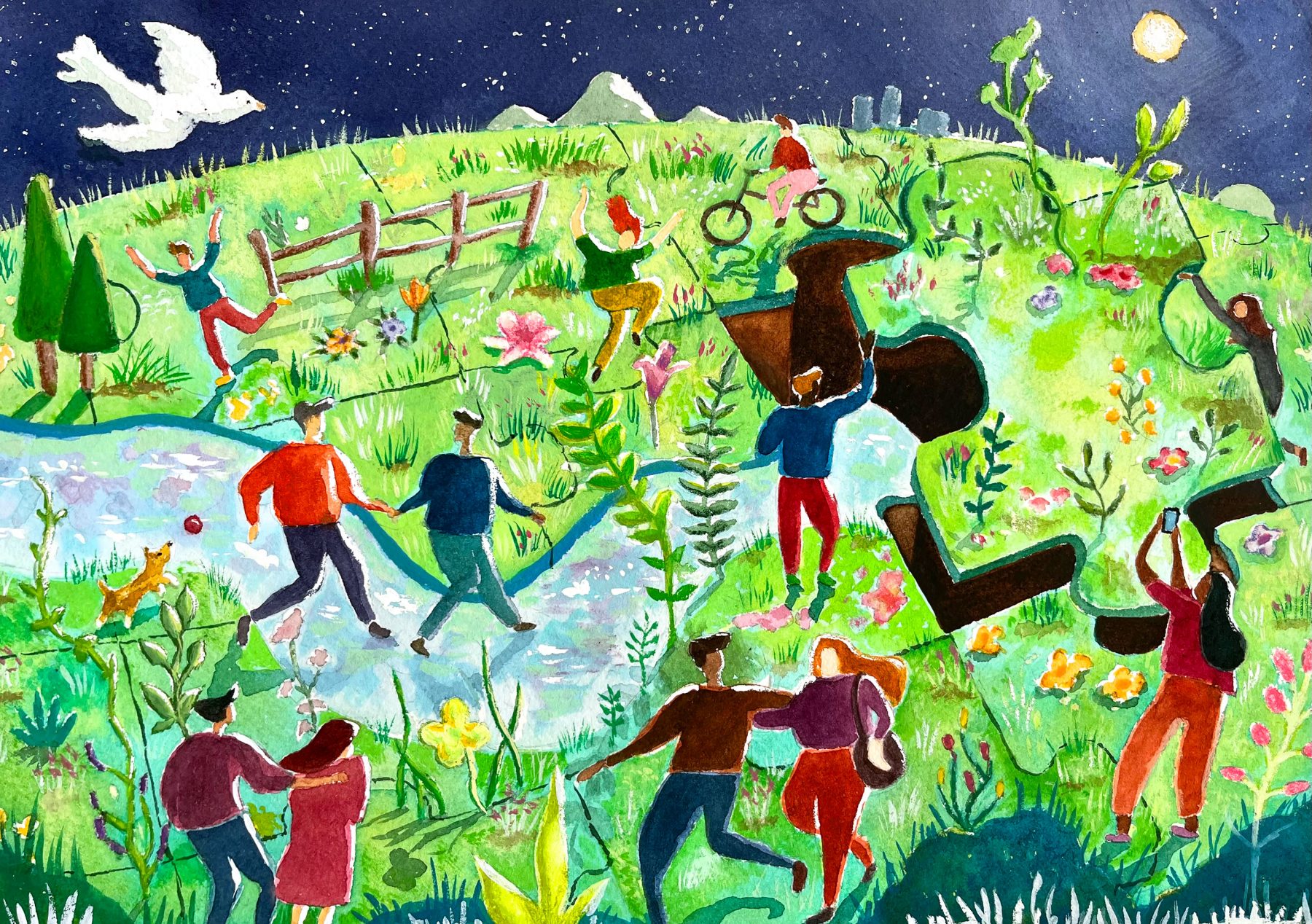
Santa Clarita Winner: Classic Art
Lifeless
Sallie R Butler
Legacy Academy
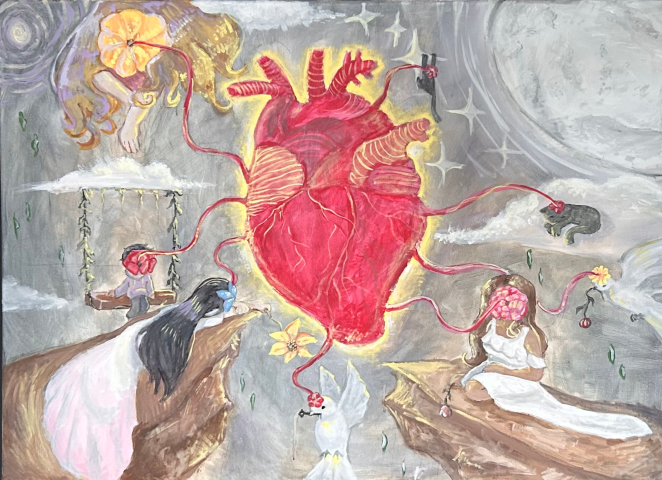
Santa Clarita Winner: Classic Art
Visions in a Shoebox
Leah Be
Academy of the Canyons
Santa Clarita Winner: Classic Art
Fight for Freedom
Ida Sabery
Saugus High School
Santa Clarita Winner: Classic Art
Growing Generations
Diya Boini
Academy of the Canyons
Santa Clarita Winner: Classic Art
An Eccentric Embrace
Maanvi Rudraprakash
Santa Clarita Winner: Classic Art
The Global Heartbeat
Claire Holt
Santa Clarita Valley International School
Digital Art Winners!
Santa Clarita Winner: Digital Art
The Ideas of Today
Josh Justin
Academy of the Canyons
Santa Clarita Winner: Digital Art
The Network of Tomorrow
Justin Paredes
Academy of the Canyons
Santa Clarita Winner: Digital Art
Louder Together
Emma Carlos
Academy of the Canyons
Essay Winners!
“Voices of Today, Visions of Tomorrow”
As the United States approaches its 250th year and Sister Cities International marks seventy years of global partnership, this moment invites reflection. History is not simply a record of events; it is a dialogue between generations. The voices of the past have shaped the political freedoms, cultural exchanges, and global relationships we now inherit — but it is the responsibility of today’s youth to expand those ideals into a more empathetic and interconnected future.
The founding voices of the United States articulated principles of liberty and equality that were aspirational, not complete. Across decades, reformers, activists, and ordinary citizens challenged the nation to live up to those promises. Their courage demonstrates that progress is rarely immediate; it is cumulative. Because of them, democratic participation, expanded civil rights, and global cooperation are not abstract ideals but lived realities. Yet those advancements did not occur passively. They required individuals willing to speak when silence would have been safer.
If I could address the youth of the past, I would acknowledge the risk embedded in their hope. They worked toward a future they would never fully see. To the youth of tomorrow, I would offer a different warning: comfort can be as dangerous as injustice. When rights feel secure, engagement declines. But democracy and global peace demand sustained attention.
In the next 250 years, global friendship must move beyond symbolic partnerships and into sustained collaboration. Programs connecting cities across nations illustrate that diplomacy does not begin in conference rooms; it begins in classrooms and communities. When young people share language, art, and lived experiences with peers from cities such as Tena, Ecuador and Sariaya, Philippines, they develop cultural literacy that no textbook can replicate. Exposure replaces assumption. Dialogue replaces distance.
Honoring tradition does not require preserving it unchanged. Instead, it requires preserving its purpose. The founding generation valued self-governance and civic responsibility; modern youth must extend those values globally. In an era defined by climate challenges, technological acceleration, and political polarization, new voices must include those historically marginalized as well as those directly affected by emerging crises. Representation is not symbolic — it is practical. Diverse perspectives generate more sustainable solutions.
My vision of tomorrow is not utopian harmony but disciplined empathy: a world in which disagreement coexists with mutual respect, and connection outweighs isolation. Building that future begins with intentional listening, active participation, and cross-cultural engagement.
The voices of the past secured a foundation. The voices of today must decide what will stand upon it.
“Voices of Today, Visions of Tomorrow”
Isabella Celaya
Saugus High School
“Visions of Tomorrow”
If someone were to say “think of the future” to you, what would you picture? Most people’s minds would go to a technologically advanced metropolis, with colors ranging from light grey to dark grey. But, thinking of the human race itself, and the wants and needs of every person in it, is this really what the future looks like? Maybe for some places. Maybe already developed cities like L.A., New York, Tokyo, and London have this in their futures. But will this hold true for the rest of the world?
There is reasonable doubt that all of the world will be straight out of sci-fi. Some places will lag behind a bit. Not just small countries that are too poor, not just the towns that are too small. Many big cities will have small corners tucked away where everything will be as it is now, or as it was a hundred years ago. Why? Well, have you ever been to a historic landmark that was virtually untouched other than plaques and tourist traps? Think of the Eiffel tower, the Parthenon, the Colosseum. This is because these places are historic sights, and millions of people flock there each year just to see these ruins, some of which are still in use today. Just this year, 2026, nearly twenty-thousand people have been entering the Sistine Chapel daily.
Hundreds of years from now, these buildings will still be in use. If they collapse, architects will build new ones, like they have for the Globe theater in London, which burned down in the sixteenth century but was rebuilt exactly the same only a few decades ago. And in the future, there will be more of these landmarks. The Statue of Liberty, the Space Needle in Seattle, the Empire State Building, just to name a few in America, are more modern, but already have thousands of people rushing to see them. In the future, these sites will be historic gold mines, surrounded by tourists day and night. They will be kept in perfect condition, exactly the way they look today.
For hundreds of years, the human race has been lifted up by history. We learn from past mistakes, look back on great accomplishments, and leave things behind for future generations. It seems entirely reasonable for people a hundred years from now to think of history the same way as we do. And what do we do with historical places? We preserve them. We keep them in perfect condition for people to see. Places where famous events happened, places that are improbable for a time, places that changed the world are kept sacred.
So maybe in the future, the world will be full of crazy technology and sites from every time-travel movie ever made. But, knowing humanity’s obsession with history, and knowing what we already know about ancient landmarks, it is safe to say that whatever the future holds, a bit of now will stay with us, tucked in little corners of time.
Visions of Tomorrow
Athena Davis
Saugus High School
“Sister Cities Essay”
People have always pushed boundaries. Sometimes, it’s curiosity, sometimes, it’s that stubborn voice inside—This matters. I need to do something. Socrates couldn’t just sit back; he challenged what everyone thought they knew, forcing people to think thoroughly about truth and meaning. Gandhi and Martin Luther King Jr. didn’t just hope for a better world—they organized, marched, showed everyone what nonviolent resistance can achieve. Marie Curie and Albert Einstein? They didn’t stick to the script. They rewrote it, changing science and how we understand the world. And then, there are all the regular folks—teachers, artists, families—keeping traditions alive, pulling communities together, building the real foundations we lean on every day. They do it quietly, but with grit, with persistence, with purpose.
Still, just inheriting the past isn’t enough. Look around. Wild weather, breakneck tech, rising inequality, and divisions that run bottomless. These escalating problems need bold ideas, real guts. Right now, young leaders from overlooked communities are stepping up, bringing fresh answers shaped by real experience. Indigenous wisdom teaches us to live with the land, not just on it. Scientists and ethicists wrestle with AI, gene editing, and how to use data responsibly, all while testing the boundaries of ethics. Artists and storytellers keep reminding us that underneath everything, people share the same hopes, the same fears. When we genuinely listen to each other, ideas sharpen, trust builds, and working together doesn’t seem impossible anymore.
Tradition isn’t about freezing history behind glass; it’s about keeping what works, letting go of what doesn’t, and letting concepts change as we do. Languages, rituals, art only survive if Buck 2
people let them mature while remembering where they came. Today, children from all over the world can collaborate on research, creative projects, problem-solving through digital networks. This unorthodox of teamwork is real—friendships form, stereotypes break down, understanding grows when people pull together. Clean water, fighting disease, sustainable farming, better tech—working side by side builds trust that politics can’t manufacture and leads to solutions that last. The future should be built on dignity, and sustainability, and working together. Schools need to teach the younger generation to think for themselves, ask resilient questions, and self-advocate when it counts. Technology should lift us up, not concede freedom or privacy. Governments should open doors, not slam them shut.
Real strength is empathy—the courage to care about someone else’s story. Communities, institutions, cultures—they all have an essential part to play: supporting clean energy, fair healthcare, research across borders, amplifying voices that have been quiet for too long . History proves what determined people can accomplish. Now, the burden resides with the next wave of leaders to step up—with guts, creativity, wisdom—to shape a future that’s robust, fair, open, honestly hopeful. If we work together, honor what came before, welcome change, tackle problems side by side, we can build a world that preserves what matters, solves what’s in front
Sister Cities Essay
Garrett Buck
Sister Cities Essay
“The World We Create”
The world we live in today was shaped by countless voices throughout history, from great leaders who built flourishing societies to activists who spoke about dreams of a better world. Every generation leaves behind a new world for the next to inherit, improve, and cherish. Each time the world expands to new horizons, it brings new advancements in fields such as technology, architecture, healthcare, and science. But beyond tall skyscrapers and innovative new appliances, one key piece is often overlooked, although it is the most important. At the core of an evolving world lie the values and ideals that guided the last and will build the next. These beliefs of peace, compassion, and respect don’t change as fast as technology. Still, the way we apply them to others changes every day. Today’s technology connects us instantly across the world, but our values are the true source of understanding.
Contrary to what we imagine about the future, these guiding values are truly decided by us. They are not decided by fate or by major leaders. These beliefs are created and spread by everyone, regardless of influence or wealth. The essential question is, “How do we ensure that the values that we leave behind will be those that will help future generations thrive?” The future I envision today is a world created and connected by empathy and mutual respect. The United States was built 250 years ago on priceless principles of freedom and equality. In the next 250 years, using the understanding of the world that we have gained since, I believe we can build a society that includes many more ideals that will shape a better world. To reach that state of global growth, there are many voices that we must listen to today. Day by day, global warming is steadily worsening. All around us, the world’s natural resources and biodiversity are being depleted. If we do not take action now, the planet may never be the same. Voices advocating for environmental action, human rights, and countless others must be heard now. In a time where relationships between countries are growing uncertain, it is more important than ever to recognize how compassion and global friendship are choices that we should strive to make. To the youth of the past, your ideas and accomplishments have shaped our world today, and will continue to for many years. To the youth of the future, remember that the past is filled with lessons, from those who came before you that persevered through challenges, as you will too. I believe that our goal as global citizens is not only to practice kindness and promote global friendship, but to celebrate the last 250 years of growth and development in the US and across the world. We must strive to hear the voices that matter now and make the next 250 years more peaceful, empathetic, and compassionate than the last.
The World We Create
Srikushal Vagvala
Rio Norte Junior High
“Sister Cities Essay”
The voices of the past helped create how the world is today in many ways. It was shaped by the invaluable voices of children, immigrants, writers, regular people who spoke up for positive change. Their ideas, courage, sacrifices helped solidify the rights and opportunities many of us have now. Yet, our world still faces serious problems. If we want to build a better tomorrow, influential voices must rise.
Throughout history, powerful voices have spoken up and changed society for the better. For example, leaders like Martin Luther King Junior courageously disavowed racism and fought for civil rights. His timeless speeches continue to inspire millions and help afford civil liberties to all people, of all walks of life. Another important voice is Susan B. Anthony. She fought for women’s right to vote. Due to her steadfast efforts and others like her, American women gained more equality and now are able to have nearly the same opportunities as men.
These inspirational voices from the past remind us that speaking up matters. The freedom many United States citizens enjoy, like voting, going to school, or practicing their 1st amendment right, exists because someone in the past demanded change. Unfortunately, not every voice is heard. There were many groups that were ignored or silenced because of the way they looked, and poverty. This is why it’s important to think about the voices that are still silenced or too afraid to speak up.
Today, many people, such as teenagers, are becoming some of the strongest new voices. For example, Malala Yousafzai, a Pakistani activist that has spoken out about how important it is for education for girls around the world. Facing danger, countless death threats, and disapproval from others, she continued to advocate for change. She shows how age does not determine ability for, you can speak up regardless of what age you are and still make a difference.
In my opinion, to build a better tomorrow, we must listen and learn from voices that are overlooked. People from different cultures, from diverse backgrounds, are the ones we should be listening to and learning from because these people see other things most people don’t see or don’t even hear about. If we include more perspectives, we create solutions that are much more effective.
We all are able to use our voice. You don’t have to be famous to make a difference even if it’s a small one. Doing something, even as little as standing up for bullying makes a greater change than you think. It’s small actions like this that help shape a positive future.
The voices of the past built the world we live in today. We can carry the torch forward by being more open minded to everyone; treating everyone with respect does more than you think, even with the smallest action. By doing this, we create a that is more equal, understanding, and hopeful for everyone.
Sister Cities Essay
Ellen Savoie
Saugus High School
Original Music Winners!
Santa Clarita Winner: Original Music
To a Wall
Kingsley Perez
Saugus High School
Santa Clarita Winner: Original Music
Remnants
Riley Racela
Academy of the Canyons
Santa Clarita Winner: Original Music
Echoes of Our Great Nation
Gina Intravartolo
West Ranch High School
Photography Winner!
Santa Clarita Winner: Photography
Wings of Unity, Solidarity & Amity
Kayton Wickremasuriya
Saugus High School
Poetry Winners!
“The Voice I Inherited”
I did not learn how to speak alone.
My voice traveled to me
through time,
through hands that shook
but never let go.
It comes from those who marched
when silence was easier,
from those who wrote their truth
on streets, on paper, on skin,
even when the world refused to listen.
It comes from young voices
told they were too small,
yet loud enough
to bend laws,
to shift minds,
to crack open the future.
Because of them, I know this:
a trembling voice
is not a weak one.
It is a voice carrying history,
echo,
inheritance.
We are the generation
who caught their noise in our hands
and learned how to shape it
into meaning.
If they spoke
to carve the path,
we will speak
so it never disappears again.
“The Voices I Inherited”
Cecilia Ojeda
Academy of the Canyons
“Moving the World”
I hear the voices of the past
Building futures that will last
A future vision set in stone
Building cities, building homes
Now we’ll answer the call when it’s needed
Those needing help will see it heeded
Voices, songs, forever sung
Fill the mouths of old and young.
Tradition honored, cultures strong
Our strength was in unity all along
In maintaining the union of which we are fond
Friendships forged, an unbreakable bond
But among the chorus, new voices emerge
We need to make room; their voices converge
They have new ideas, new goals in mind
Their ideas make answers easier to find
From common goals that we all hold
The new world that our minds mold
New ideas and solutions birthed
Working together, we can move the Earth
Infinitely grateful to historical voices
Looking ahead at possible choices
In hearts and minds throughout all the lands
The future of the world is in our hands.
“Moving the World”
Ian Garcia
Academy of the Canyons
“Voices of Today, Visions of Tomorrow”
The voices of today, rise with our dreams,
Bringing hope into the future, like bright moonbeams.
From one Sister City to another, together we speak as a whole,
In this journey for unity, we each have a role.
Through brave steps, and words of grace,
Martin Luther King Jr spoke for every race.
Rosa Parks refused to give up her seat,
She created a world where hope and equality meet.
Malala Yousafzai created the inclusive classroom,
Nelson Mandela made his country bloom.
They raised their voices, clear and bold,
And spoke of dreams that gleamed like gold.
They did their part, and paved the way,
Now it’s our turn, starting today.
Glaciers are melting at the Earth’s Pole,
And Climate Change is taking a huge toll.
As impacts of AI are starting to roar,
Empathy is needed more than before.
My vision of tomorrow has us all in unity,
Hand in hand as a whole community.
As a voice of today, I say “hello,”
Together, let’s start shaping the visions of tomorrow.
“Voices of Today, Visions of Tomorrow”
Aryahi Patankar
Arroyo Seco Junior High School
International Winners!
“Echoes of Our Great Nation”
Gina Intravartolo
West Ranch High School
“What Do You See Inside”
Caroline Tsan
Academy of the Canyons
“A World Where We Rule”
The future is always near and a time of change is arriving. There will be an era where the next generation will rule the world and shape it to the best of their ability. Especially the younger generations like Gen Z and Alpha. Being a Gen Alpha myself, I can tell you that we can exceed limits and create a world like no one has ever seen. Although we are just adolescents and young adults, we have experienced the world first hand and have endured many challenges such as Covid and countries waging wars with each other. Due to this, we have obtained a lot of knowledge about the real world and we are ready for it- to step up and become the future of this planet.
Since I was young, many things have happened to our world and I had to be involved in it some way or another. Technology is the basis of everything these days and so much has happened these past couple of years that have gravely impacted me. Before I could even go to school properly, Covid hit and we were in quarantine. I had to adapt fast and learn the basics of technology like how to use Google Classroom or learn about social media. Some people my age had experienced family deaths during this tragic time, but they didn’t quit. Despite the depression, anxiety, and PTSD, they took one step forward at a time and made it through.
Social media has a colossal influence on kids my age. We have been on screens before we were 7-8 years old and AI has taken over society and changed it drastically. ChatGPT, CoPilot, all of those websites have a heavy influence on kids as well as TikTok and SnapChat not to mention the influence of video games. Kids revolve around technology so much that it’s a part of their life. As high of a chance as there is bad, the next generation can use this to their advantage and govern the world in a positive way.
These ongoing wars between countries have also affected how kids perceive the world in both positive and negative ways. I can’t see my family in India in person due to the breakout. Kids are being separated from their families, robbed of their loved ones, and everything they know has been dilapidated. This can cause severe PTSD and therapy won’t be enough. However, these types of situations can also make kids more aware. They now know what it means to experience violence first hand or lose at the hands of war. Children and adolescents now know the “real world”.
People may say that “Oh, you’re just kids. You wouldn’t understand,” or “Kids can’t understand emotion. They’re too young.” However, that isn’t necessarily the case. We have grown to modify and blend in faster than older generations. The article “Hopes and Dreams for the Run of Gen Z” states that, “ That’s what helps us adapt to significant changes in life compared to older generations. We have open minds, imagination, and free will, and we can accept change,” (Sass, 1). This shows that though there have been some instances where things go wrong with us, or past experiences show that we can build the future into a place of hope and where people can express themselves. I can say from my experiences that this generation has been through a lot from a young age, but that can help us grow. Help us develop into good human beings that have potential.
To sum it all up, I hope for a future where people my age can govern and construct a world of peace, prosperity, and development. When I have kids, I want them to love their country, their world, and do the same in return. They won’t have to go through the same problems we did growing up. We made their childhood into a flourishing adulthood where they won’t have to worry about major issues and conflicts. A time of peace and happiness.
“A World Where We Rule”
Anagha Vadrevu
Rio Norte Junior High